
PCR Annealing Temperature Guide
How to turn primer melting temperatures into a working annealing temperature — and how to optimize it.
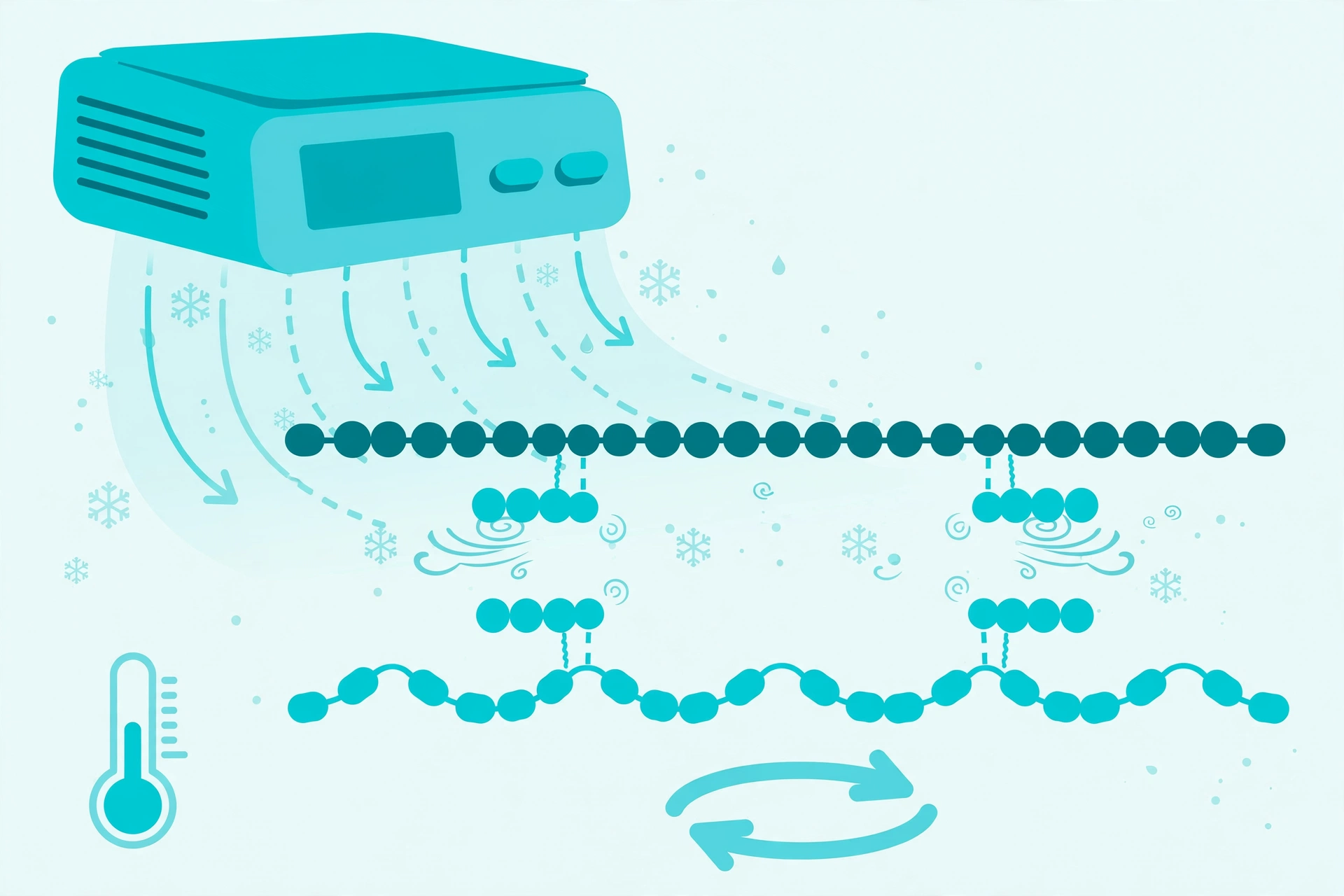
Tm is a property; Ta is a decision
It helps to keep two ideas separate. The melting temperature (Tm) is a thermodynamic property of the primer–template duplex: the temperature at which half the duplexes are melted. The annealing temperature (Ta) is a protocol parameter: the temperature your thermal cycler actually holds during the annealing step of each cycle. Tm informs Ta, but nothing obliges them to be equal — and in practice Ta is usually set a few degrees below Tm.
The standard starting point
The most widely used rule of thumb is:
Ta ≈ (lower primer Tm) − 5 °C
Using the lower of the two primer Tm values matters: the primer with the lower Tm is the limiting one, and an annealing temperature tuned to the higher-Tm primer may leave the other barely bound. This is exactly what the primer Tm calculator reports as the "Estimated Starting Annealing Temperature" when both primers are entered. With only one primer, the estimate is labeled as less reliable, because the limiting primer of the pair is unknown.
This is a starting point for optimization, not a guaranteed optimum. Polymerase, buffer composition, and additives all shift the practical ideal, which is why experimental confirmation is essential.
Why the offset works
Annealing a few degrees below Tm keeps most primer molecules bound while still discriminating against mismatched binding. Raise Ta toward or above Tm and binding becomes too weak — amplification efficiency collapses. Lower Ta too far and primers tolerate mismatches, giving non-specific products, smears, and primer-dimers. The −5 °C offset is a compromise that works well for typical primers; it is not derived from first principles, so treat it as convention rather than law.
Optimize with a gradient PCR
The standard way to find the best Ta is a gradient PCR: a single run in which different wells of the thermal cycler block are held at different annealing temperatures, typically spanning about 10 °C centered on your estimated Ta (for example, estimated Ta ± 5 °C). After the run, compare the wells: the optimal temperature gives a strong single band of the expected size with minimal non-specific products or primer-dimer.
For quantitative PCR, the equivalent readout is the melt curve and the amplification efficiency across the gradient. Whichever readout you use, include a no-template control to distinguish genuine product from primer-dimer artifacts.
Troubleshooting by temperature
- No product at all: the annealing temperature may be too high, or the primers may not match the template. Try lowering Ta by a few degrees and verify primer sequences against the template.
- Non-specific bands or smears: Ta is likely too low. Raise it in 1–2 °C steps, or redesign primers for better specificity.
- Primer-dimers dominating: check for 3′ complementarity between the primers, reduce primer concentration, and consider raising Ta slightly.
- One primer clearly underperforming: suspect a Tm mismatch between the pair; re-balance lengths so the Tm values fall within about 5 °C.
Special cases
Some protocols deliberately deviate from the rule. Touchdown PCR starts with a high annealing temperature and lowers it each cycle, favoring the most specific binding events early. Two-step PCR merges annealing and extension at a single higher temperature for suitable polymerases and amplicons. Long or GC-rich amplicons sometimes need adjusted conditions beyond what primer Tm alone suggests. In all these cases, the estimated Ta remains a useful reference — it just isn't the final word.
Key takeaways
- Tm describes the duplex; Ta is the temperature you program into the cycler.
- Start at Ta ≈ 5 °C below the lower primer Tm.
- Confirm and refine with a gradient PCR spanning roughly ±5 °C.
- Raise Ta to improve specificity; lower it to rescue weak amplification.
- Every estimate here is a starting point — validate experimentally.
Get your starting estimate now: calculate primer Tm and annealing temperature for your primer pair.