
Primer Melting Temperature (Tm) Guide
What Tm means at the molecular level, how calculators estimate it, and which assumptions you should know about.
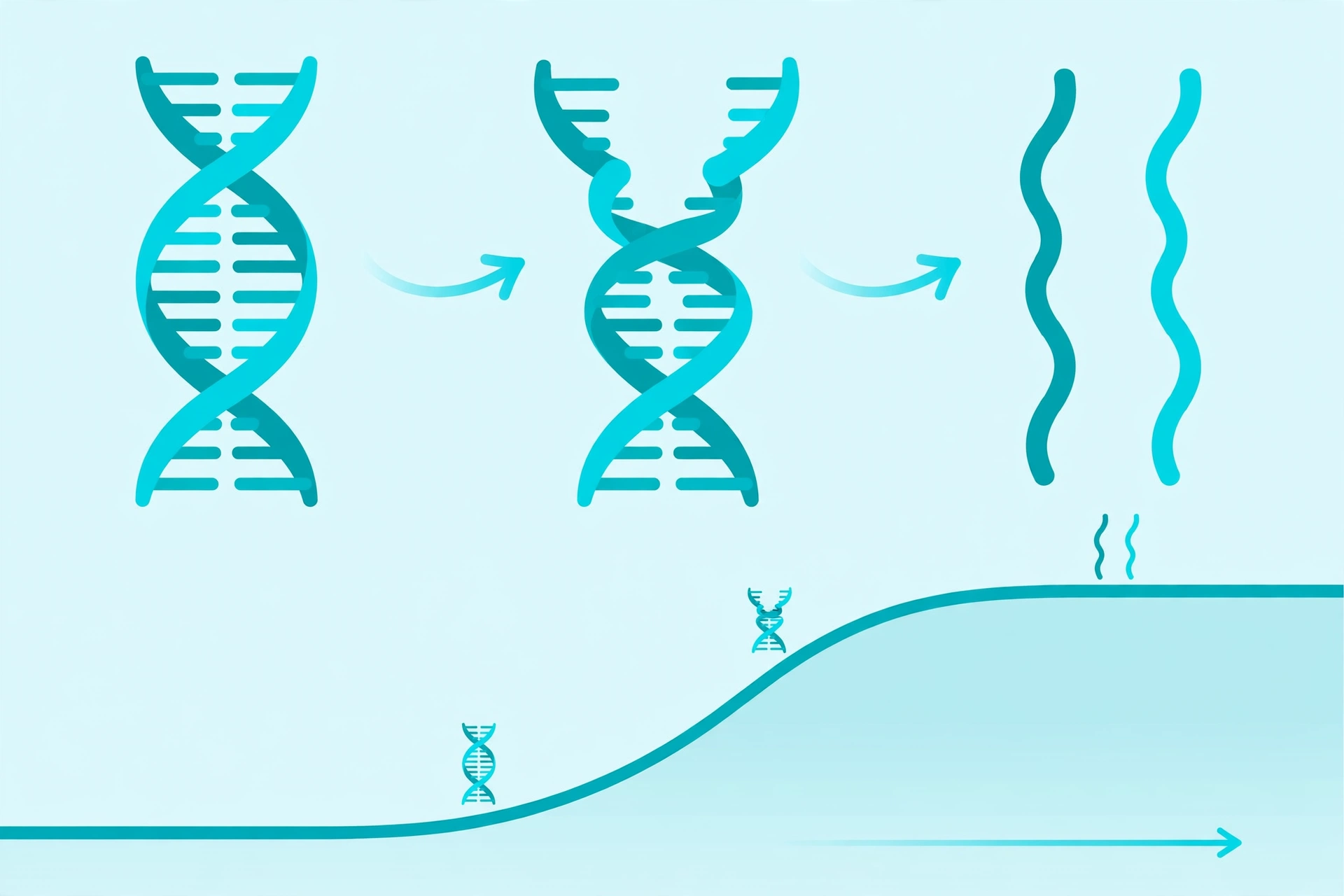
What Tm actually measures
Melting temperature is defined for a specific duplex: a primer bound to its complementary strand. As temperature rises, the hydrogen bonds and base-stacking interactions holding the two strands together break, and the duplex "melts" into single strands. The Tm is the temperature at which half of the molecules are in the duplex state and half are single-stranded, under defined solution conditions.
This is an equilibrium property, which is why it can be predicted from thermodynamics. It is also why Tm is not a fixed attribute of a sequence alone: the same primer has a slightly different Tm at different salt concentrations, different primer concentrations, and different pH. Any calculator that reports a Tm without stating its assumed conditions is giving you an incomplete answer.
Why Tm matters in PCR
Each PCR cycle includes an annealing step where primers bind the template. Set the annealing temperature well above the primer Tm and binding is too weak for efficient amplification. Set it well below and primers tolerate mismatches, producing non-specific products and primer-dimers. Tm is therefore the reference point from which the annealing temperature is chosen — commonly starting about 5 °C below the lower primer Tm, as explained in our annealing temperature guide.
The nearest-neighbor model
The most widely respected predictive approach is the nearest-neighbor model. Its key insight is that duplex stability depends less on individual base pairs than on adjacent pairs of base pairs: the stacking interaction between one base pair and its neighbor contributes most of the stability. The model assigns measured enthalpy (ΔH) and entropy (ΔS) values to each of the ten unique dinucleotide steps — for example, a 5′-CG-3′ step paired with 3′-GC-5′ has different parameters than a 5′-AT-3′ step.
This calculator uses the unified SantaLucia (1998) parameter set. The total ΔH and ΔS are summed over every dinucleotide step in the primer, a duplex-initiation term is added (ΔH +0.2 kcal/mol, ΔS −5.7 cal/(mol·K)), and the melting temperature at 1 M Na⁺ follows from the standard relation:
Tm = ΔH / (ΔS + R·ln(C/2)) − 273.15, with C the primer concentration in mol/L and R the gas constant. The division by two reflects a non-self-complementary duplex with one strand in excess, the normal PCR situation.
Concentration and salt corrections
Two corrections adapt the 1 M Na⁺ reference value to realistic conditions. First, the primer-concentration term above: Tm depends on the logarithm of concentration, so doubling the primer concentration raises Tm by a modest, predictable amount. Second, a salt correction converts the result to the reaction's ionic strength. Positive ions shield the negatively charged phosphate backbones, stabilizing the duplex, so higher salt means higher Tm.
This calculator estimates a monovalent-equivalent sodium concentration from your inputs as [Na⁺]eq = [monovalent] + 4·√(max(0, [Mg²⁺] − [dNTP])), recognizing that dNTPs chelate Mg²⁺ roughly one-to-one and only free Mg²⁺ counts. It then applies the Owczarzy (2004) correction, after von Ahsen (2001):
1/Tm(Na⁺) = 1/Tm(1M Na⁺) + (4.29·fGC − 3.95)·10⁻⁵·ln[Na⁺] + 9.40·10⁻⁶·ln²[Na⁺], with Tm in Kelvin and fGC the G/C fraction. This formula was validated for sodium concentrations around 0.069–1.02 M; the calculator clamps the equivalent concentration to 0.05–1.5 M and tells you when clamping occurred.
The Wallace rule (basic method)
The basic method offered here is the Wallace rule: Tm = 2×(A+T) + 4×(G+C). It assigns 2 °C per A–T pair and 4 °C per G–C pair. It is a rough approximation intended for short oligos (often quoted for sequences under about 14 bases), and it ignores concentration, salt, and nearest-neighbor stacking effects entirely. It is useful as a quick sanity check, but for real primer design the nearest-neighbor result is the more defensible estimate.
Assumptions and limitations
Every model simplifies reality. This calculator's engine assumes ΔH and ΔS are temperature-independent, applies no terminal A–T penalty and no symmetry correction (appropriate for non-self-complementary primer–template heteroduplexes), and does not model pH, molecular crowding, DMSO or betaine additives, or secondary structures such as hairpins and primer-dimers. Results are theoretical estimates for planning, not laboratory-grade predictions — always confirm with a gradient PCR or equivalent experiment.
Key takeaways
- Tm is the temperature where half of a primer's duplexes are melted — an equilibrium property, not a fixed constant.
- The nearest-neighbor model predicts Tm from dinucleotide stacking thermodynamics plus concentration and salt corrections.
- The Wallace rule is a quick approximation; it ignores reaction conditions.
- Salt stabilizes duplexes (raising Tm); primer concentration enters logarithmically.
- Documented assumptions beat hidden defaults — compare calculators on equal settings.
Ready to run the numbers? Calculate your primer's Tm with adjustable salt and concentration settings, or continue to the GC content guide to see how base composition drives Tm.