
Primer Hairpin in PCR: Why It Happens & How to Fix It
Your primer looks perfect on paper, but it keeps folding into a tiny loop instead of binding your template. Here is why that happens and how to stop it.
Quick answer
A primer hairpin forms when a primer folds back on itself, creating a stem-loop that blocks template binding. Check the hairpin ΔG (a measure of fold strength): keep it weaker than −3 kcal/mol, and redesign anything at −9 kcal/mol or stronger. DMSO at 2–10% can rescue borderline cases.
What Is a Primer Hairpin?
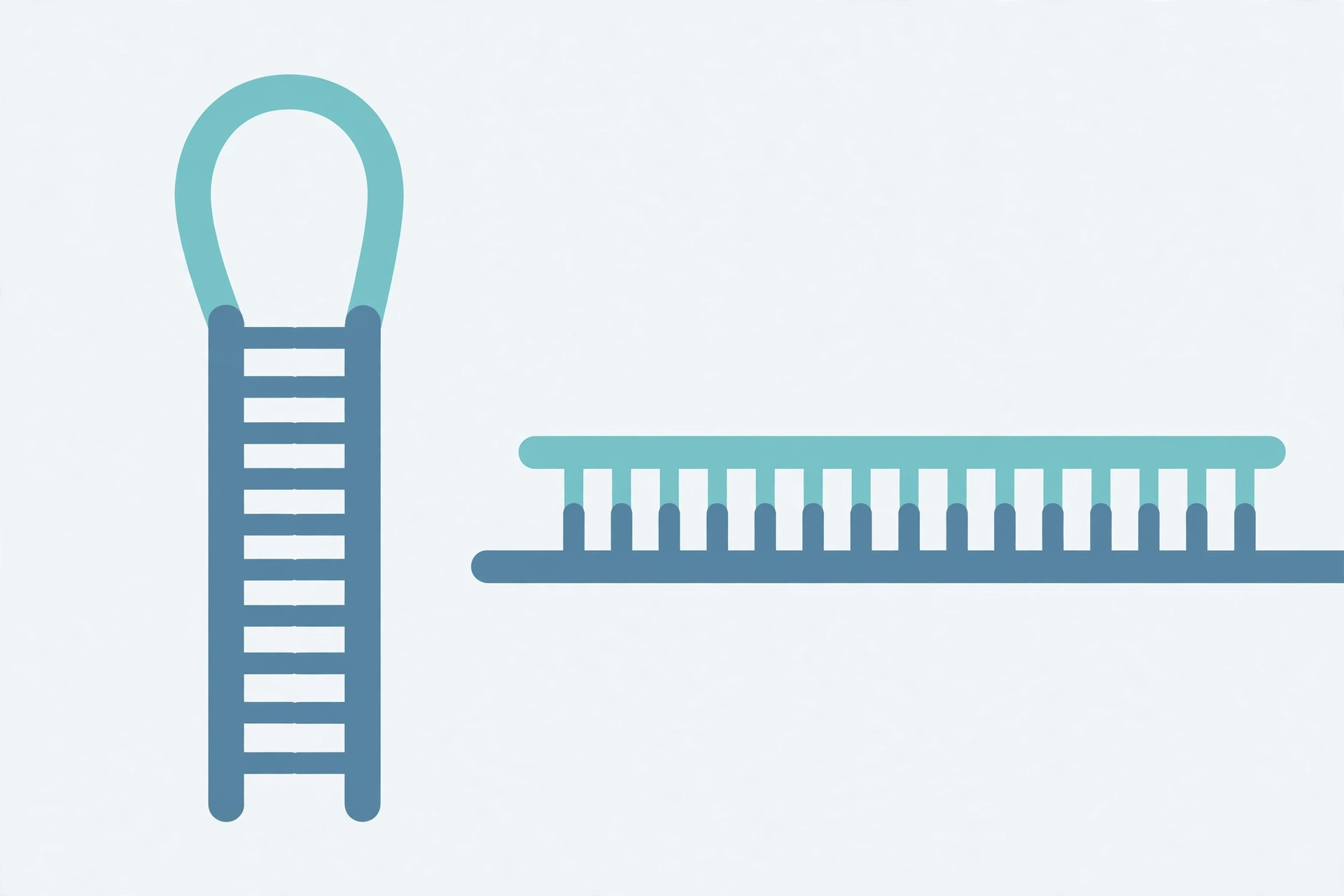
A primer hairpin is a small loop a single primer ties itself into. When one stretch of the primer is complementary to another stretch within the same primer, the strand folds back and base-pairs with itself — a double-stranded stem topped by an unpaired loop.
Why does that wreck your PCR? A folded primer is a busy primer — it cannot anneal to your template DNA. Every molecule locked in a hairpin is one less molecule available for amplification. We see this complaint in lab forums every week: "my primers look fine, but I get nothing." Half the time, a hairpin is the culprit nobody checked.
Don't confuse it with a primer dimer: a dimer involves two primers sticking to each other, while a hairpin is one primer folding solo.
Why Do Primers Form Hairpins?
Hairpins come from self-complementary sequences:
1. Inverted repeats. If the 5′ end of your primer reads like the reverse complement of a stretch near the 3′ end, the two regions snap together. Even 4–5 complementary bases can seed a stable stem.
2. GC-rich runs. G–C pairs use three hydrogen bonds versus two for A–T, so GC-heavy stems are stubbornly stable. This is one more reason our GC content guide warns against long G/C stretches.
3. Palindromic sequences. True palindromes are hairpin magnets. Restriction-site tails added to primer 5′ ends are a classic source — always re-check secondary structure after adding a tail.
4. Complementarity near the 3′ end. The most dangerous kind. If the fold involves the 3′ end, polymerase can extend the hairpin itself, "locking in" the structure. A 3′ hairpin is far worse than one confined to the 5′ end.
How Do You Know If Your Primer Has a Hairpin Problem?
You check the ΔG — Gibbs free energy — of the predicted hairpin. In plain terms, ΔG tells you how badly the primer wants to stay folded. More negative means a stronger hairpin; positive means the fold won't form at all. Free tools like IDT's OligoAnalyzer calculate this in seconds — IDT even has a dedicated FAQ on checking hairpins and dimers.
Here is the rule of thumb most labs use:
| Hairpin ΔG | What it means | What to do |
|---|---|---|
| Positive or near 0 kcal/mol | Fold won't form under reaction conditions | Ignore it — your primer is fine |
| 0 to −3 kcal/mol | Weak fold, melts apart at annealing temp | Usually harmless; proceed |
| −3 to −9 kcal/mol | Gray zone — may compete with template binding | Try DMSO or redesign if PCR struggles |
| −9 kcal/mol or stronger | Stable hairpin that outcompetes the template | Redesign the primer — don't fight it |
Caveat: ΔG calculators assume standard salt and primer concentrations. Cold reactions or concentrated primer stocks can make a borderline hairpin behave worse than the number suggests.
6 Fixes That Actually Work
1. Redesign the primer — the real fix. Shift the primer a few bases up- or downstream to break up the self-complementary stretch. This is the only fix that eliminates the cause. Our primer design guide has the full checklist.
2. Add DMSO (2–10%). DMSO disrupts secondary structures and is the classic rescue for GC-rich, hairpin-prone primers. Stay under 10% — above that it inhibits Taq polymerase itself.
3. Try betaine or BSA. Betaine (around 1 M) equalizes AT and GC base-pair strength, loosening GC-heavy stems. Cheap experiment before you reorder primers.
4. Raise the annealing temperature. A hotter annealing step melts weak hairpins while still permitting specific template binding — provided your primer Tm allows it. Check with our Tm calculator and annealing temperature guide.
5. Lower the primer concentration. Hairpin formation is concentration-dependent. Dropping from 0.5 µM to 0.2 µM sometimes tips a borderline primer into working.
6. Move the tail. If the hairpin comes from an added 5′ tail (restriction site, adapter, barcode), move it to the other primer or shorten it. Tails are the most common avoidable cause I see — people add them, forget to re-check structure, and blame the polymerase.
Key takeaways
- A primer hairpin is one primer folding into a stem-loop on itself — distinct from a primer dimer, which involves two primers.
- Check hairpin ΔG before ordering: weaker than −3 kcal/mol is safe, −9 kcal/mol or stronger means redesign.
- Hairpins involving the 3′ end are the most damaging because polymerase can extend them.
- Redesigning the primer is the permanent fix; DMSO (2–10%) is the best quick rescue.
Frequently Asked Questions
What ΔG value means my primer hairpin is a problem?
Keep hairpin ΔG weaker (more positive) than −3 kcal/mol during design. IDT's OligoAnalyzer flags any secondary structure at −9 kcal/mol or more negative as likely problematic — that hairpin will outcompete template binding.
Can a primer with a hairpin still work in PCR?
Sometimes, yes. Weak hairpins (ΔG near zero or positive) melt apart at annealing temperature. Strong hairpins (ΔG more negative than −9 kcal/mol) usually kill amplification — redesign the primer.
How is a primer hairpin different from a primer dimer?
A hairpin is intramolecular — one primer folds back on itself. A primer dimer is intermolecular — two primers bind each other. Both waste primer, but hairpins are fixed by redesigning one primer while dimers require fixing the pair. The Scientist's primer overview covers both pitfalls side by side.
Does DMSO help with primer hairpins?
Yes, DMSO at 2–10% disrupts secondary structures including hairpins, but above 10% it inhibits Taq polymerase. It is a useful rescue for GC-rich primers, though redesigning the primer is the cleaner long-term fix.
Designing new primers? Run them through our free Tm calculator, and read the primer design guide for the full checklist that catches hairpins before you order.