
Fix Non-Specific Amplification in PCR: 7 Proven Ways
Extra bands, wrong-sized products, or a smeary lane on your gel? Here is how to read the pattern, find the cause, and fix it — in the order that wastes the least of your week.
Quick answer
Non-specific amplification means your PCR copied more than your target — you see extra bands or a smear on the gel. Fix it by raising the annealing temperature (start at Ta = lowest primer Tm minus 5 °C), lowering primer concentration to 0.2–0.3 µM, cutting cycles to 25–30, and switching to a hot-start polymerase.
What Is Non-Specific Amplification?
PCR is supposed to copy one thing: the DNA stretch between your two primers. Non-specific amplification happens when the primers also bind to wrong places that are similar enough to hold on — and the polymerase copies those too. On a gel that looks like your expected band plus company: extra bands at wrong sizes, a ladder of small fragments near the bottom, or a full-lane smear. We see this question in lab forums every week, and it is almost never a mystery — one of a handful of reaction conditions is simply too permissive.
Read Your Gel Before You Touch Anything
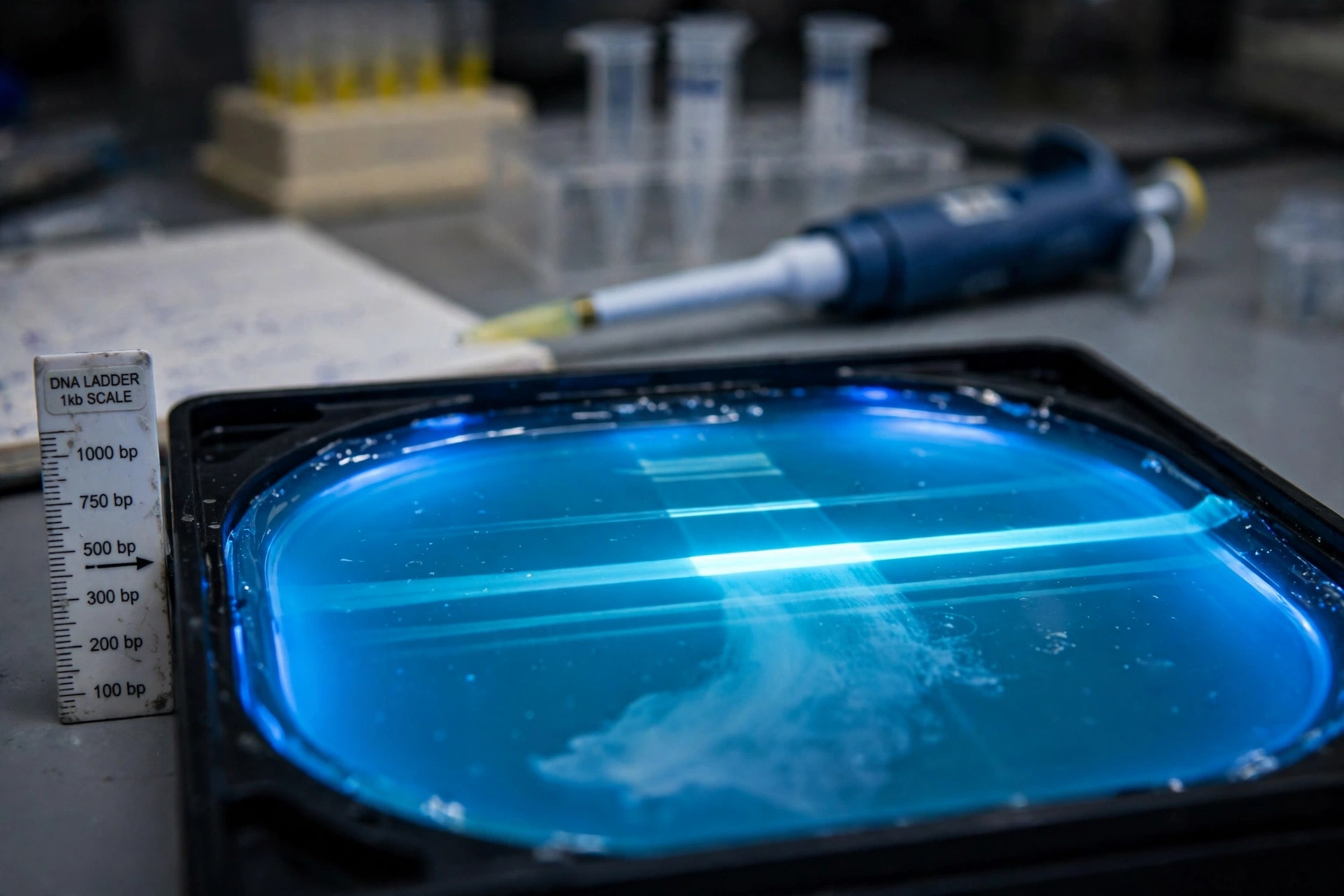
The band pattern is a diagnosis, so match what you see before changing anything:
- One clean band, wrong size: primers binding the wrong genomic site (mispriming).
- Ladder of small bands at the bottom: primer multimers — primers extending each other. Closely related to primer dimers.
- Full-lane smear: too much template, too-low annealing temp, or too many cycles.
- Band in the no-template control: stop — that's contamination. Clean up and make fresh reagents before touching conditions.
7 Fixes, in the Order I Would Actually Try Them
Change one thing per run — change three and you will never know which one worked.
1. Verify your controls. Five minutes, zero reagents. If the no-template control shows product, decontaminate and repeat before touching anything else. This rule has no exceptions.
2. Raise the annealing temperature. Honestly, this one fixes more than half the cases. Higher Ta makes primers bind more strictly — the correct site holds on, the wrong ones fall off. For Taq, start at the lowest primer Tm minus 5 °C (check your primers with our Tm calculator); for Q5 or Phusion, NEB recommends 0–3 °C above the lowest Tm. Even better: run a gradient PCR spanning ±5 °C around your Ta and pick the hottest temperature with a strong correct band — our annealing temperature guide walks through the setup.
3. Drop the primer concentration. The working range is 0.1–0.5 µM each primer, but most reactions run perfectly at 0.2–0.3 µM. If you are at 0.5 µM or higher, excess primer is your prime suspect — see our primer dilution guide for the math.
4. Cut the cycle number. Twenty-five to thirty cycles is plenty. Past 35 cycles, even trace off-target products amplify to visible bands — if 40 cycles shows junk but 30 does not, you have your answer.
5. Titrate the MgCl₂. Magnesium is the stringency dial: more Mg²⁺ loosens binding and encourages non-specific products; less tightens it but can cost yield. Try 1.5 to 4.0 mM in 0.5 mM steps and read which lane is cleanest.
6. Switch to hot-start polymerase — or run touchdown PCR. A hot-start polymerase stays inactive below 95 °C, so nothing amplifies during setup at room temperature, where most mispriming starts (NEB Q5 Hot Start and OneTaq Hot Start are the workhorses). Touchdown PCR does the same thing differently: start 5 °C above your target Ta, drop 0.5–1 °C per cycle for 10 cycles, then hold the target Ta for 25 cycles — the early high-stringency cycles let the correct product outcompete everything else.
7. Shorten the extension time, then check the primers in silico. One minute per kilobase is enough for Taq — overlong extensions let partial, off-target products extend fully. Then run your primer sequences through BLAST or IDT's OligoAnalyzer. If the software says the primers can bind three other places in the genome, no amount of optimization will save them.
When the Answer Is "Design New Primers"
Here is the part most guides skip: if a full annealing-temperature gradient gives you no clean window — junk at every temperature — the conditions are not the problem. The primers are. Stop optimizing and redesign: 58–62 °C Tm, 40–60% GC, no 3′ complementarity, and an in-silico specificity check before ordering. Our primer design guide has the full checklist.
Key takeaways
- Read the gel first: wrong-size band = mispriming, small ladder = primer multimers, smear = too much template, NTC band = contamination.
- Raising the annealing temperature (Ta = lowest Tm − 5 °C) fixes most cases; a gradient PCR finds the sweet spot in one run.
- Drop primers to 0.2–0.3 µM, cut cycles to 25–30, and titrate MgCl₂ between 1.5 and 4.0 mM.
- Hot-start polymerase or touchdown PCR stops setup-temperature mispriming; if no Ta window is clean, redesign the primers.
Frequently Asked Questions
Should I increase or decrease annealing temperature for extra bands?
Increase it. Higher annealing temperatures make primers bind more strictly, so off-target binding drops away. Start at Ta = lowest primer Tm minus 5 °C, or run a gradient to find the hottest temperature with a strong correct band.
Do extra bands mean my primers are bad?
Usually not. Extra bands normally mean your conditions are too permissive — annealing temperature, primer concentration, and MgCl₂ are the usual culprits. Only blame the primers if a full gradient shows no clean window at all.
Can I still use a PCR product with extra bands?
For cloning or sequencing, yes — cut the correct band out of the gel and purify it. For diagnostic or quantitative PCR, no: extra products contaminate your measurement.
Is a gel smear the same as non-specific amplification?
Related, not identical. A smear usually means too much template, degraded template, or far too many cycles; discrete extra bands point to primers binding the wrong sites.
Before your next run, plug your primers into our free Tm calculator to confirm your starting Ta, and bookmark Bento Bio's troubleshooting walkthrough and BenchChem's MgCl₂ notes (PDF) for the titration details.