
How to Store PCR Primers: Shelf Life & Storage Guide
Primers are tougher than most people think — but bad storage still kills them. Here is exactly how to keep yours working for years.
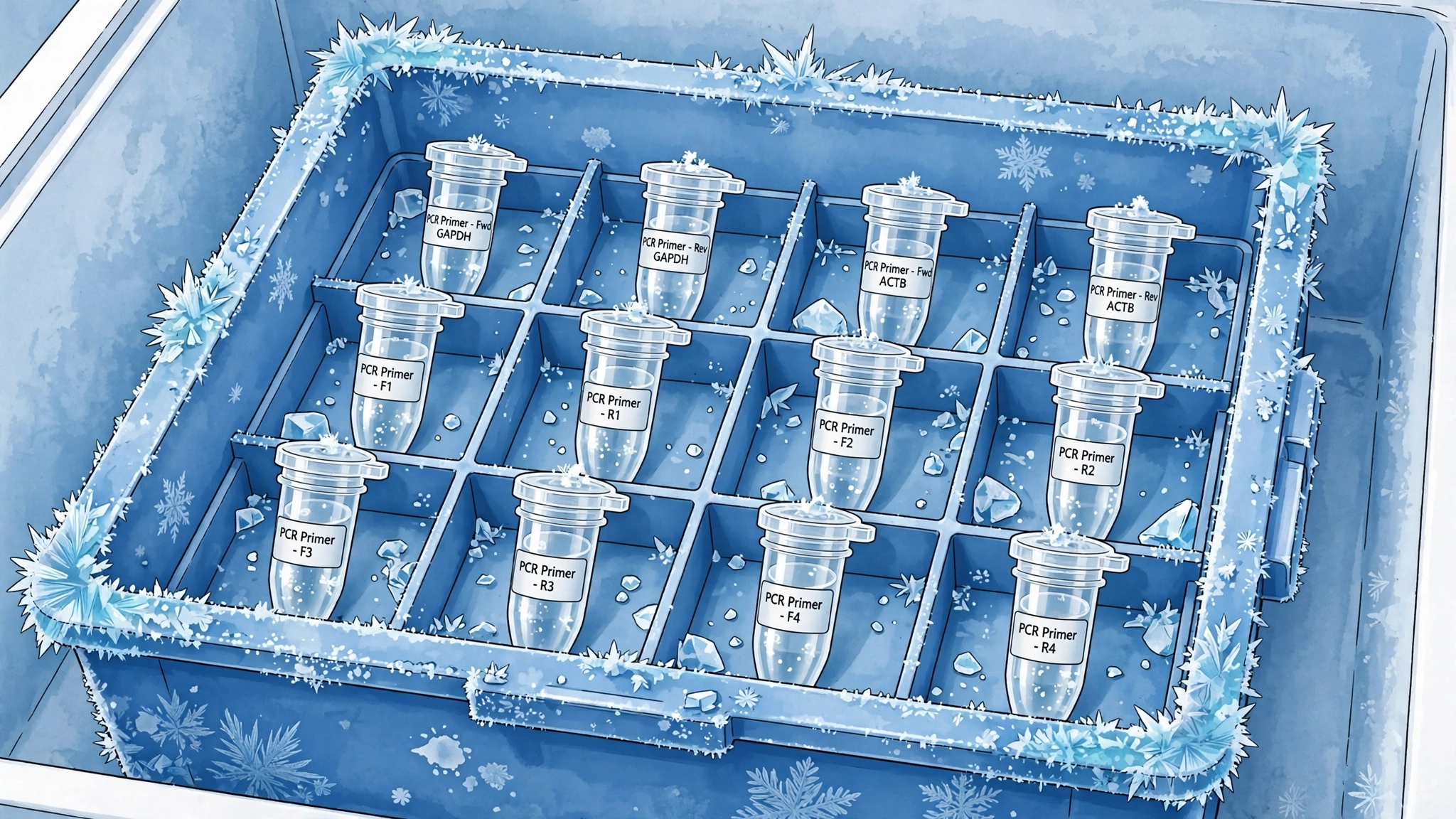
Quick answer
Store PCR primers lyophilized at −20 °C for a year or more, or resuspend them in TE buffer (pH 8.0) to 100 µM and freeze small 10 µM working aliquots at −20 °C. Keep one working tube at 4 °C for daily use, limit freeze–thaw cycles to about 10, and avoid frost-free freezers that cycle in temperature.
Why Does Primer Storage Matter?
PCR primers are short, single-stranded DNA (usually 18–25 bases), and that makes them fragile — heat, acidity, nucleases, and repeated freeze–thawing all break them down. Degraded primers don't announce themselves; bands just fade. New primers arrive lyophilized (freeze-dried) and are tough dry — the trouble starts once you add liquid.
Primer Storage: A Quick Reference
Different primer forms want different treatment:
| Primer form | Where to keep it | How long it lasts |
|---|---|---|
| Lyophilized (dry pellet, unopened) | −20 °C, or room temp in the dark | 1+ years; 25 weeks even at 37 °C |
| 100 µM stock in TE buffer | −20 °C (not a frost-free freezer) | Years — 24+ months in stability studies |
| 100 µM stock in nuclease-free water | −20 °C | 6+ months; shorter than TE |
| 10 µM working aliquots | −20 °C, thawed one at a time | Months per aliquot |
| Working tube in daily use | 4 °C | Several weeks to a few months |
| Fluorescently labelled primers/probes | −20 °C, dark (amber tubes or foil) | ~1 year after resuspension |
How Do I Resuspend Primers?
The pellet is often invisible — a faint film at the tube bottom. Spin the tube before opening, or you'll lose half your primer to the cap. We've all learned that one the annoying way.
For the liquid, choose TE buffer (10 mM Tris, 1 mM EDTA, pH 8.0) over water for long-term stocks. Nuclease-free water is often slightly acidic, and acid slowly hydrolyses DNA. TE holds the pH at 8.0, where DNA is most stable, and its trace of EDTA mops up metal ions that nucleases need. One caveat: keep EDTA at 1 mM or below — more can chelate the Mg²⁺ your polymerase needs.
For stock concentration, 100 µM is the standard. The trick: multiply the nanomoles on the tube by 10 — that's the microliters of TE to add (25 nmol → 250 µL). Pipette up and down a dozen times to dissolve the pellet, then label the tube with primer name, date, and concentration. Our primer dilution guide covers the full maths.
What's the Best Storage System?
Here's the system I'd recommend to anyone: two tiers.
Tier 1 — the master stock. Your 100 µM tube lives at −20 °C and is thawed only to make new working aliquots — a few times a year at most.
Tier 2 — working aliquots. Dilute stock 1:10 to 10 µM, split it into small 50–100 µL tubes, and freeze them at −20 °C. Thaw one at a time and keep the open tube at 4 °C until it's empty.
No tube thaws more than once or twice, so freeze–thaw damage stops mattering. One more trap: skip frost-free freezers — they warm above 0 °C to melt frost, and that slow cycling degrades primers over months. We see this in lab forums every few weeks: year-old primers die mysteriously after living in the auto-defrost freezer. Manual-defrost −20 °C is far better.
How Many Freeze–Thaw Cycles Can Primers Survive?
More than you'd expect, but don't push your luck. An IDT stability study found primers at −20 °C intact for at least 24 months in TE, water, or even dry — and 30 freeze–thaw cycles caused no measurable damage. A 2024 BMC Research Notes study thawed qPCR primer mixes monthly for five months with no significant performance change. Still, Thermo Fisher advises capping labelled probes at about 10 cycles — a sensible ceiling for ordinary primers too. With the two-tier system above, you'll never get near these limits anyway.
How Can I Tell If Primers Have Degraded?
Suspect your primers when a working PCR gives weak or absent bands while template, polymerase, and cycling are unchanged — with a clean no-template control ruling out contamination. In qPCR, Cq values creeping later is the giveaway.
To confirm, make fresh working solution from your master stock and repeat the PCR. Bands back? The old tube was the problem — toss it. Master stock dead too? Reorder; degraded primers can't be repaired. First rule out other causes in our no-bands troubleshooting guide — and if the gel is messy rather than empty, see the primer dimer guide.
Key takeaways
- Resuspend in TE buffer (pH 8.0) to 100 µM — nmol × 10 gives the microliters to add.
- Two tiers: a rarely-thawed 100 µM master stock at −20 °C, plus single-use 10 µM working aliquots.
- Avoid frost-free freezers — their defrost cycles silently degrade primers over months.
- Primers survive 24+ months frozen and dozens of freeze–thaws — but aliquoting means you never test those limits.
Frequently Asked Questions
Can I store PCR primers at 4 °C?
For short-term use only — several weeks to a few months at 4 °C. Freeze stocks at −20 °C for anything longer.
Should I resuspend primers in TE buffer or water?
TE buffer for long-term stocks. Water is often slightly acidic, which slowly hydrolyses DNA; TE holds pH 8.0.
Can I mix forward and reverse primers in one tube for storage?
Yes, if you always use the pair together — but keep separate tubes too, in case you reuse one primer later.
How long do lyophilized primers last before resuspending?
At least a year at −20 °C; studies show 25 weeks even at 37 °C. Unopened tubes survive months at room temperature.
New primers on the way? Check them with our free Tm calculator and read the primer design guide — good storage can't fix a bad design. Sources for the numbers above: Thermo Fisher's custom oligo FAQ and a 2024 BMC Research Notes stability study.