
Touchdown PCR Protocol: Step-by-Step Guide for Beginners
Smears and extra bands on your gel? Touchdown PCR fixes non-specific amplification with a smarter cycling program — no new reagents required.
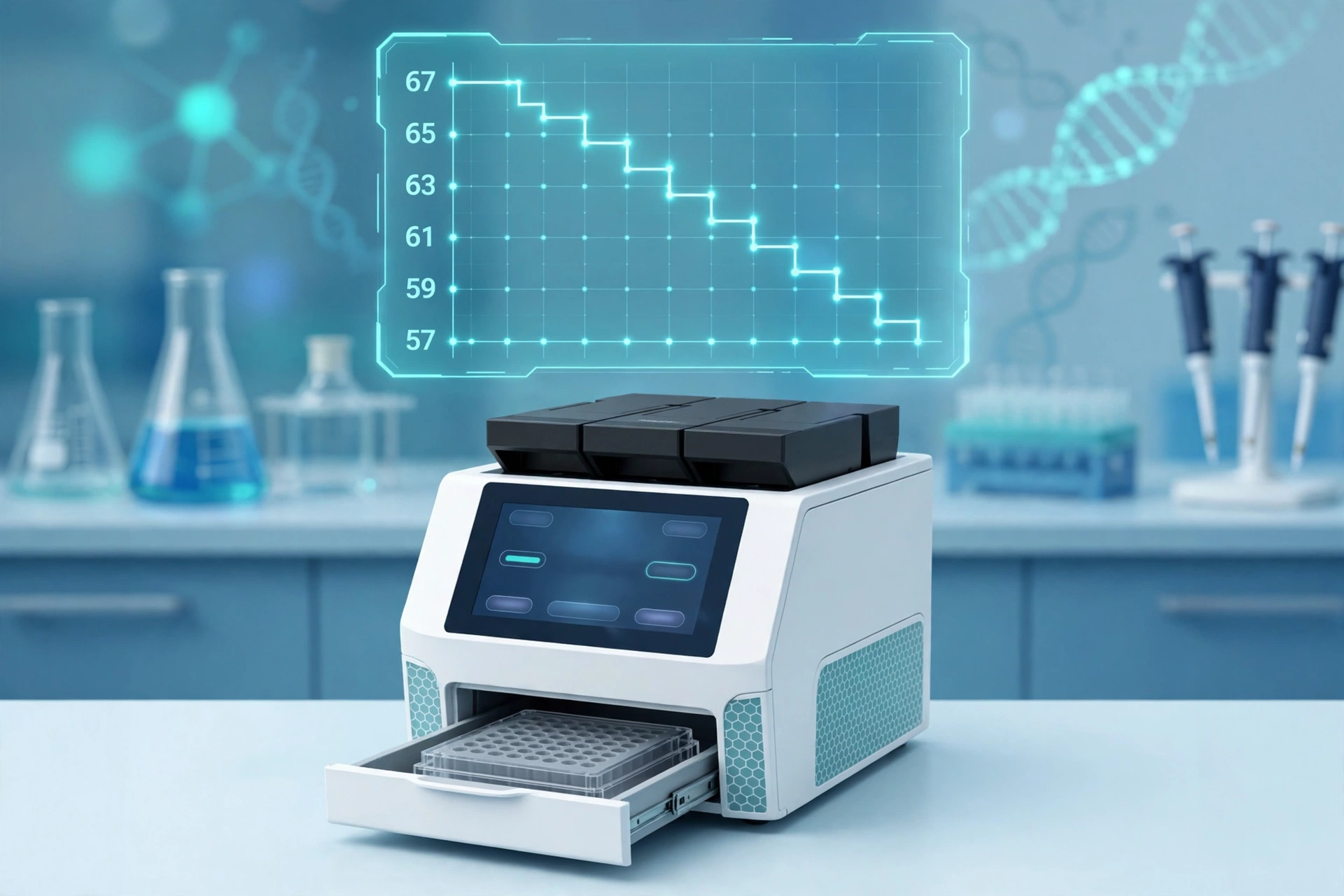
Quick answer
Touchdown PCR is a cycling method where annealing starts 5–10 °C above your primer Tm and drops about 1 °C per cycle until it reaches the target Tm. Those early high-stringency cycles amplify only the perfect primer–template match, which then outnumbers any non-specific product in the remaining cycles. Use it when gels show smears, extra bands, or stubborn primer-dimers.
We see this question in lab forums every week: "I get three bands where there should be one — what now?" The researcher has already tried raising the annealing temperature, and the gel still looks like a ladder. Here's the thing: guessing one better temperature is a slow game. Touchdown PCR tests a whole staircase of temperatures inside a single run — starting strict, relaxing only after the correct product has taken the lead.
What Is Touchdown PCR — and Why Does It Work?
Touchdown PCR is not a different chemistry or a special reagent. It is a cycling program — the same primers, master mix, and thermocycler, just a smarter temperature schedule. In a normal PCR the annealing temperature stays fixed for all 30–35 cycles. In touchdown PCR it starts high and steps down ~1 °C per cycle until it reaches your target, then holds there.
Why does that fix smears? Think of it as a race with a staggered start. At the high starting temperature only a perfectly matched primer–template pair can bind — off-target binding can't hold on. So the first few cycles produce only correct product, which then outnumbers competitors thousands to one by the time the temperature relaxes. PCR is exponential: a 3–4 cycle head start means the right amplicon dominates and the wrong ones never catch up. This also starves primer-dimers, which form most easily at low stringency.
Example: primer Tm 57 °C → anneal from 67 °C, drop 1 °C/cycle for 10 cycles, then 20–25 cycles at 57 °C. Two phases — touchdown, then fixed — that's the entire trick.
When Should You Use Touchdown PCR?
Reach for it in these situations:
- Smears or multiple bands on the gel — the classic sign of non-specific amplification.
- Primer-dimers that won't go away after the usual fixes (lower primer concentration, higher annealing temp).
- Tricky templates — GC-rich regions or complex genomic DNA where your primers have near-matches elsewhere in the genome.
- Multiplex PCR, where several primer pairs in one tube multiply cross-binding chances.
And when not to bother: if your standard PCR already gives one clean, bright band, touchdown buys you nothing — it can even cost a little yield. Don't fix what isn't broken.
How Do You Program a Touchdown PCR?
Here is a complete worked example. First, get your primer Tm — run both primers through our Tm calculator and take the lower value. Say it's 57 °C:
| Step | Temperature | Time | Cycles |
|---|---|---|---|
| Initial denaturation | 95 °C | 3:00 | 1 |
| Denaturation | 95 °C | 0:30 | 10 (annealing drops 1 °C per cycle: 67 → 57 °C) |
| Annealing (touchdown) | 67 °C → 57 °C | 0:45 | |
| Extension | 72 °C | 0:45 | |
| Denaturation | 95 °C | 0:30 | 20–25 (fixed phase) |
| Annealing (fixed) | 57 °C | 0:45 | |
| Extension | 72 °C | 0:45 | |
| Final extension | 72 °C | 5:00 | 1 |
| Hold | 4 °C | ∞ | — |
On a real cycler, create two cycling blocks. In the first block's annealing step, use the decrement function: −1.0 °C per cycle × 10 cycles. Every modern thermocycler has this option. For amplicons over 1 kb, extend the 72 °C step to ~1 minute per kilobase.
What If Touchdown PCR Doesn't Fix It?
Touchdown handles most specificity problems, but not all. Work through these in order:
Still seeing smears? Your starting temperature may be too low. Try Tm + 12 °C, drop primer concentration to 0.2–0.3 µM, or cut 5 cycles from the fixed phase — late cycles amplify everything, including junk.
No product at all? You overshot — the touchdown phase was too stringent. Shorten it to 5 cycles, or run the fixed phase 1–2 °C below Tm.
If nothing works, redesign. No cycling trick rescues genuinely bad primers. Check for 3′ complementarity and off-target matches with our primer design guide before burning another week on optimization.
Touchdown PCR vs Gradient PCR — Which Should You Run?
A gradient PCR tests fixed annealing temperatures side by side — it tells you which temperature is best. Touchdown PCR bakes the whole range into one tube without revealing the optimum. Run a gradient once when developing a brand-new assay; use touchdown as the routine rescue when an established PCR misbehaves. For background, Bitesize Bio's touchdown PCR walkthrough and the original Nature Protocols method paper are both worth a read.
Key takeaways
- Touchdown PCR starts annealing 5–10 °C above the primer Tm and drops ~1 °C per cycle — same reagents, smarter program.
- Early stringent cycles give the correct product a head start non-specific products can't overcome.
- Use it for smears, extra bands, stubborn primer-dimers, and multiplex PCR — skip it when your PCR is already clean.
- Standard recipe: 10 touchdown cycles (Tm+10 → Tm), then 20–25 fixed cycles at Tm.
- Combine with hot-start polymerase for maximum specificity on difficult templates.
Frequently Asked Questions
How many degrees should touchdown PCR drop per cycle?
1 °C per cycle over 10 cycles, starting ~10 °C above the primer Tm. A gentler 0.5 °C variant exists too.
Can touchdown PCR be used for qPCR?
Yes — it's especially useful in SYBR Green qPCR, where non-specific products distort melt curves. Confirm your instrument supports a programmed annealing decrement.
Does touchdown PCR reduce yield?
Slightly — early stringent cycles are less efficient. If product is faint, add 3–5 cycles to the fixed phase.
What is the difference between touchdown PCR and hot-start PCR?
Touchdown is a cycling program; hot-start is a polymerase inactive until the first denaturation. They combine well for maximum specificity.
Setting up a new assay? Get your starting temperatures from our free Tm calculator first.