
How to Calculate Primer Efficiency in qPCR (With Example)
One slope, one formula, and the difference between numbers you can trust and numbers you can't.
Quick answer
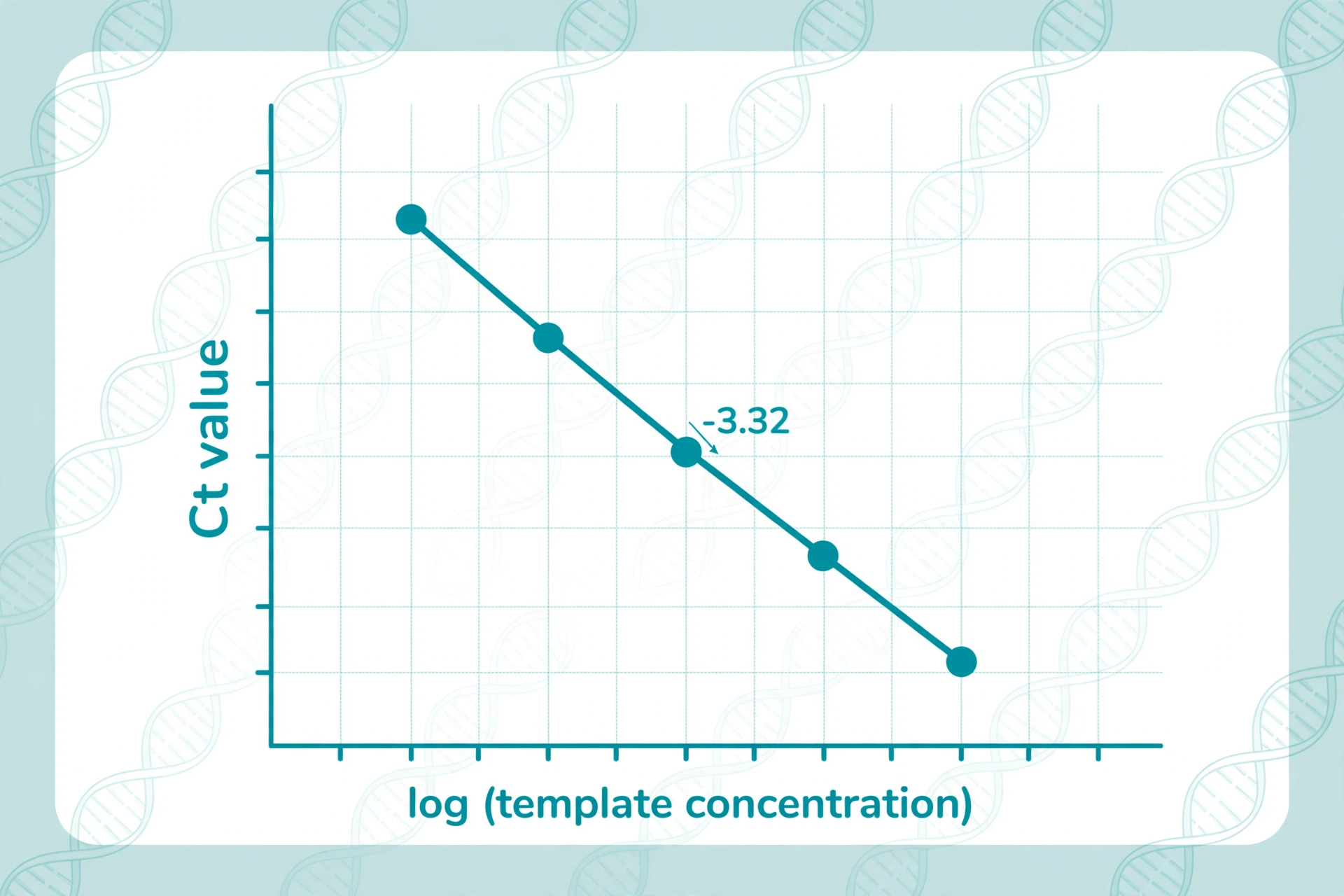
qPCR primer efficiency tells you how close your reaction is to perfect doubling each cycle, and you calculate it from your standard curve's slope with E = (10(−1/slope) − 1) × 100%. A slope of −3.32 means 100%. Anything between 90% and 110% is fine — outside that range, your primers, pipetting, or cycling conditions need work.
What Is Primer Efficiency, Exactly?
In a perfect PCR, DNA doubles every cycle: 2, 4, 8, 16… Primer efficiency is how close your real reaction gets to that ideal, as a percentage. 100% = perfect doubling.
Why does it matter? Relative quantification — the ΔΔCt method used to compare gene expression — assumes your target and reference genes amplify at nearly the same efficiency. If your target amplifies at 82% and your reference at 100%, your "2-fold upregulation" is mostly math artifact.
Measure it once, properly, and file it away.
How Do You Calculate Primer Efficiency?
The standard curve method is the one that counts:
1. Build a dilution series. Make a 5-point, 10-fold serial dilution of your actual template: 1×, 1:10, 1:100, 1:1000, 1:10000.
2. Run qPCR in triplicate. Every dilution gets three replicates — pipetting noise at the dilute end is the top reason curves come out wrong.
3. Plot Ct against log₁₀ of starting quantity. Ct on the vertical axis, log of relative template amount on the horizontal — more template means earlier Ct, so the line slopes downward.
4. Fit a straight line and read the slope. Add a trendline in any spreadsheet and note the slope and R².
5. Plug the slope into the formula: E = (10(−1/slope) − 1) × 100 — in Excel, with the slope in A1: =(10^(-1/A1)-1)*100.
Why −3.32? With perfect doubling, a 10-fold dilution shifts Ct by log₂(10) ≈ 3.32 cycles.
A Worked Example With Real Numbers
A realistic dataset:
| Dilution | log₁₀ quantity | Ct (mean of triplicates) |
|---|---|---|
| 1× | 0 | 17.2 |
| 1:10 | −1 | 20.5 |
| 1:100 | −2 | 23.8 |
| 1:1000 | −3 | 27.1 |
| 1:10000 | −4 | 30.4 |
Regression gives slope −3.30, R² = 0.999: (10(1/3.30) − 1) × 100 ≈ 100.9% — validated.
One hard-learned lesson: don't delete a replicate just because it spoils your slope. If you can't explain why it's bad, keep it — reviewers can smell cherry-picked triplicates.
What Should Your Efficiency Be?
Use this table to read your own result:
| Slope | Efficiency | Meaning | What to do |
|---|---|---|---|
| −3.10 | 110% | Over-efficient — artifacts | Check melt curve for primer-dimers; review pipetting |
| −3.32 | 100% | Ideal doubling | Nothing — validate and move on |
| −3.58 | 90% | Acceptable lower bound | Usable, but watch the R² and replicates |
| −4.00 | 79% | Low efficiency | Troubleshoot: inhibitors, annealing temp, primer design |
Two rules: efficiency between 90% and 110%, and R² ≥ 0.99. A perfect 100% with R² of 0.97 is still a bad assay — the points don't sit on a straight line, so the number is fiction.
What If Efficiency Is Too Low (Below 90%)?
Low efficiency means something is stopping your primers every cycle. Work through this checklist:
1. Primer design. Hairpins, dimers, and 3′ mismatches all drag efficiency down — run your pair through our primer design guide and re-check Tms with our Tm calculator.
2. Annealing temperature too high. Drop it 2–3 °C as a first experiment — see our annealing temperature guide for the starting value.
3. Inhibitors in the template. Salts, phenol, or ethanol carried over from extraction suppress polymerase — dilute the template 1:10; if efficiency jumps, clean it up with a column.
4. Extension time too short. Amplicons over ~200 bp need more than the default 30 seconds.
5. Degraded reagents. Freeze–thawed master mix and old dNTPs lose activity silently — test a fresh aliquot.
What If Efficiency Is Too High (Above 110%)?
You can't more than double DNA in a cycle — >110% means something extra is being amplified:
Primer-dimers. Run a melt curve: a broad peak below 80 °C is the giveaway — see our primer dimer guide for the seven fixes.
Non-specific products. Extra bands or melt peaks mean the primers hit the wrong targets — tighten annealing conditions or redesign.
Pipetting error at the concentrated end. An under-diluted 1× point flattens the slope and inflates efficiency — remake the series carefully.
Do You Need a Standard Curve for Every Run?
No. Measure efficiency once per primer pair, per sample type, per master mix — after that, routine ΔΔCt runs can skip the curve. Re-validate only when something changes: a new master mix lot, a different instrument, a new sample matrix, or a redesigned primer.
Key takeaways
- Primer efficiency = how close your reaction gets to perfect doubling, from the standard curve slope: E = (10(−1/slope) − 1) × 100%.
- Accept only 90–110% efficiency with R² ≥ 0.99; re-measure once per primer pair, not every run.
- Too low → suspect inhibitors, annealing temperature, or primer design. Too high → suspect primer-dimers or pipetting error.
- In Excel:
=(10^(-1/A1)-1)*100with the slope in A1. A slope of −3.32 is the textbook 100%.
Frequently Asked Questions
What is a good qPCR primer efficiency?
Between 90% and 110%, with R² ≥ 0.99. Inside that window your quantification is trustworthy; outside it, fix the assay first.
Can primer efficiency be over 100%?
Not physically — DNA can't more than double per cycle. Above 100% means artifacts: primer-dimers, non-specific products, or pipetting error.
Why isn't my standard curve slope exactly −3.32?
Small deviations are normal — only slopes pushing efficiency outside 90–110% matter.
Can I skip the standard curve and just use the ΔΔCt method?
Only after validating once. ΔΔCt assumes both primer sets amplify near 100% — measure each new pair, then skip the curve for routine runs.
Designing a new primer pair? Check its Tm with our free Tm calculator first, then run the standard curve once. For a second worked example with a downloadable Excel template, see TopTipBio's primer efficiency walkthrough, or spot-check a slope with Omni Calculator's quick efficiency calculator.