
How to Optimize MgCl2 Concentration in PCR
One salt, one afternoon, and a gel that finally makes sense. Here's the titration that sorts out most mystery PCR failures.
Quick answer
To optimize MgCl2 in PCR, start at 1.5 mM and run a titration from 1.0 to 4.0 mM in 0.5 mM steps, keeping everything else identical. Pick the lowest concentration that gives a single bright band of the right size. Too little gives faint or no product; too much gives extra, non-specific bands.
What Does MgCl2 Actually Do in PCR?
Magnesium chloride supplies Mg²⁺ ions, which do three jobs at once in a PCR tube. First, they are a required cofactor for Taq DNA polymerase — the enzyme building new DNA strands cannot work properly without them. Second, they stabilize primer-template pairing. Third, they affect the pair's melting temperature (Tm) — which is why changing MgCl2 shifts reaction specificity.
Here's the thing: because one ingredient pulls three levers at once, MgCl2 is both the most common fix and the most common hidden cause of PCR trouble. Lab forums are full of the same story every week — someone redesigns perfectly good primers twice, when a 0.5 mM magnesium change would have fixed the gel on the first try.
What Is the Right MgCl2 Concentration to Start With?
Start at 1.5 mM for a standard Taq PCR, and treat that as a starting point, not a verdict. BenchChem's magnesium optimization guide puts the typical optimal range at 1.5 to 3.0 mM, with 1.5 to 2.0 mM the usual starting window for Taq. The Biology LibreTexts PCR protocol lists 1.0 to 1.5 mM in its master-mix setup — proof that "normal" moves with your kit and buffer.
So what actually works? If your kit's buffer already contains magnesium, titrate around the kit's recommended value; with a magnesium-free buffer, start at 1.5 mM. Before you pipette anything, check your primers with our Tm calculator — a Tm below about 55 °C is already an uphill battle no magnesium tweak fully rescues. Our primer design guide covers that checklist.
How Do You Run an MgCl2 Titration?
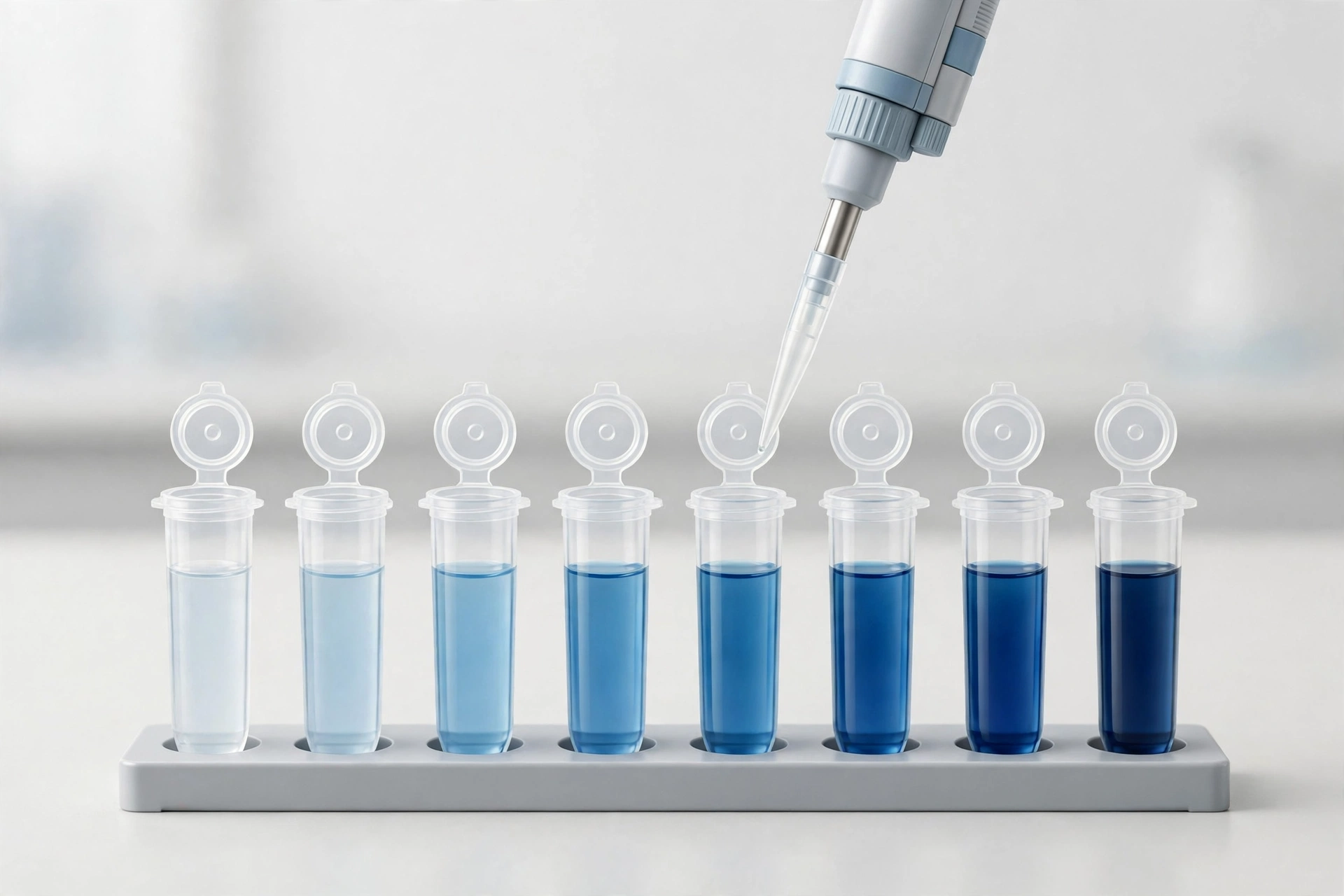
Run one titration, properly, instead of guessing a new concentration every run. Set up seven identical reactions at 1.0, 1.5, 2.0, 2.5, 3.0, 3.5, and 4.0 mM final MgCl2, changing nothing else. Make a master mix of everything except MgCl2 and template, aliquot it, then add the magnesium last — so the only variable on the gel is the one you are testing.
The pipetting maths is simple, and it trips people up more than the biology does. For a 25 mM MgCl2 stock in a 50 µL reaction, the volume you need is (target mM ÷ 25) × 50 µL. So 1.5 mM needs 3.0 µL, 2.0 mM needs 4.0 µL, and 3.0 mM needs 6.0 µL. Adjust the water so every tube still totals 50 µL. Include a no-template control at your starting concentration — if that tube lights up, you have contamination or primer dimers, not a magnesium problem.
One trap: dNTPs bind magnesium. Caister's PCR troubleshooting guide notes that dNTPs sequester Mg²⁺ ions, so a big dNTP change alters how much free magnesium is actually available. If you raise dNTPs and your band fades, check whether free Mg²⁺ is now too low.
How Do You Read the Titration Gel?
Read the gel left to right and look for the pattern, not a single pretty lane. At the low end expect faint bands or nothing: the polymerase is underpowered and primers barely hold on. Then one or two lanes show a single bright band at the expected size — your winner. Past it, extra bands creep in as excess magnesium lets primers bind places they shouldn't.
Pick the lowest concentration that gives that clean, bright target band, not the highest — more magnesium buys yield you don't need at the cost of specificity you do. If no lane is clean, magnesium wasn't your only problem: read our guides on no bands and non-specific amplification before changing three things at once.
What If the Titration Doesn't Fix It?
If every lane is blank, the problem is upstream of magnesium: dead polymerase, degraded template, or mismatched primers. If every lane is smeary, suspect template quality or quantity — and check your annealing temperature, since a temperature far below the primer Tm tolerates the same sloppy binding excess magnesium does. A clean gradient with no sweet spot is a diagnostic: stop tweaking salt and question something else.
A word from the bench: write the winning concentration on the protocol sheet. I have watched people re-optimize the same assay because the "good" value lived only in someone's head.
Key takeaways
- Start at 1.5 mM MgCl2; most standard Taq assays settle between 1.5 and 3.0 mM.
- Titrate 1.0–4.0 mM in 0.5 mM steps, changing nothing else, and pick the lowest concentration giving a single bright band.
- Check whether your buffer or master mix already contains magnesium, and remember dNTPs bind free Mg²⁺.
- Faint bands mean go up; extra bands mean go down; a gel with no sweet spot means the problem lies elsewhere.
Frequently Asked Questions
What is the best MgCl2 concentration for PCR?
Start at 1.5 mM for standard Taq PCR. Most assays settle between 1.5 and 3.0 mM, but confirm it with a titration for your own primers and template.
Does MgCl2 affect primer Tm?
Yes. Magnesium ions stabilize primer-template binding, so raising MgCl2 raises the effective Tm slightly and tolerates weaker matches — one reason excess magnesium causes non-specific bands.
Can I add MgCl2 to a master mix that already contains it?
Only if you know the starting concentration and add up to your target total. Check the datasheet first, or your titration will be measuring the wrong thing.
Should I optimize MgCl2 before or after annealing temperature?
Do MgCl2 first if your gel shows faint or missing bands, then fine-tune annealing temperature. If extra bands appear, drop MgCl2 before redesigning primers.
Further reading: the Biology LibreTexts PCR protocol shows a standard reaction setup with its magnesium values, and Caister's PCR troubleshooting guide explains how dNTPs and buffer salts interact with Mg²⁺.