
Nested PCR Protocol: A Step-by-Step Guide for Beginners
Regular PCR can't see your target? Two primer pairs in two rounds can find a handful of DNA copies — if you nail the dilution and keep round two clean.
Quick answer
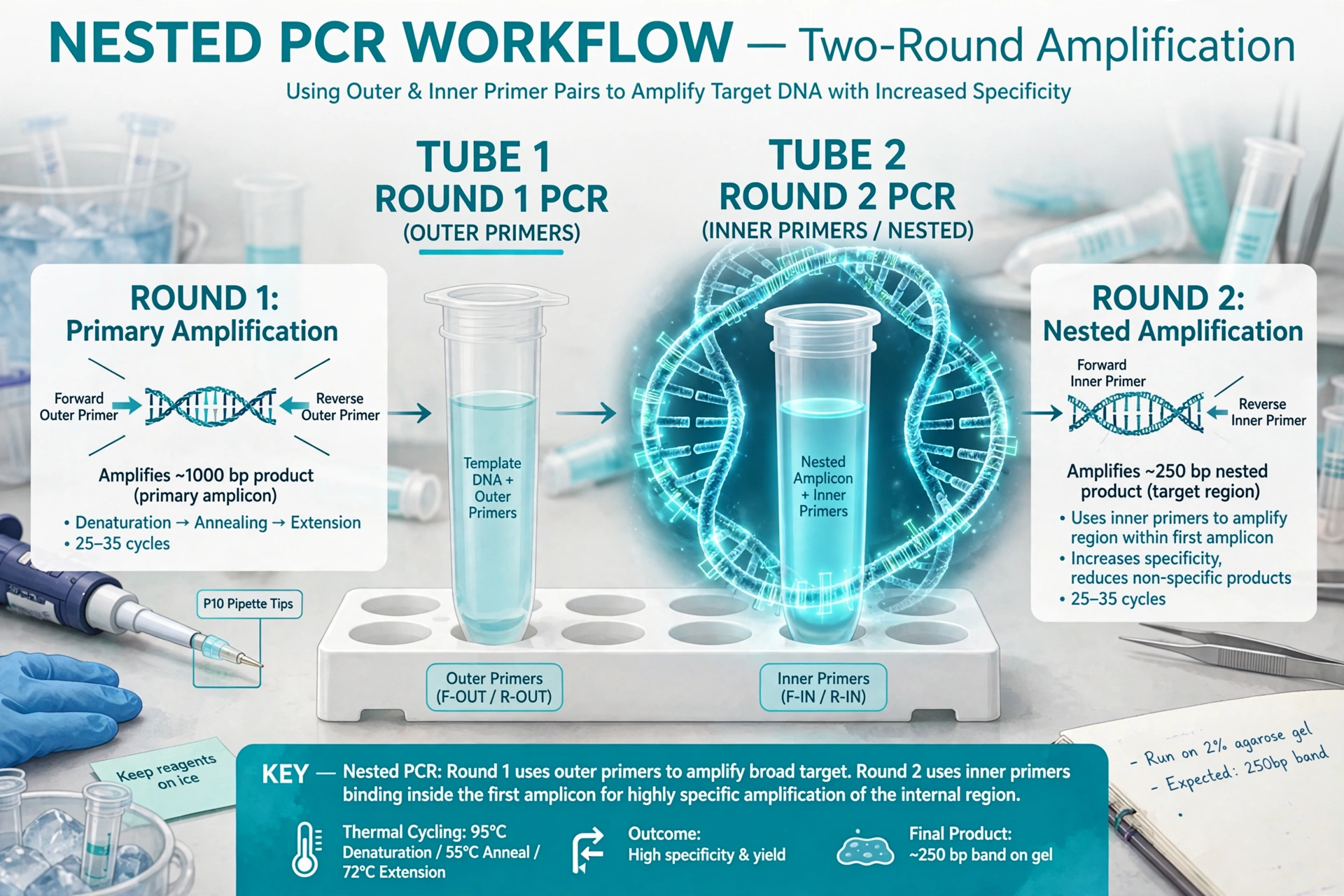
Nested PCR runs two PCRs in sequence: outer primers amplify a big region (30–35 cycles), then you dilute the product 1:50–1:100 and run a second PCR with inner primers on a smaller region inside it (another 30–35 cycles). It detects targets down to a few copies and cleans up non-specific bands. Always dilute round one, and never set up round two at the same bench as round one.
Some targets are too rare for ordinary PCR. A virus in a blood sample, a pathogen in soil, a trace plasmid — the signal drowns in noise, and the gel shows smears, ghost bands, or nothing. Nested PCR exists for exactly that moment.
What Is Nested PCR?
Round one uses outer primers amplifying a long region (800–1,500 bp); round two uses inner (nested) primers inside that product, amplifying a shorter fragment (200–500 bp) — the second primer set won't recognise round one's mistakes, so the junk drops out.
The Round-One Protocol
Round one is a standard 25 µL PCR with the outer primers:
| Component | Volume | Final |
|---|---|---|
| 2X PCR master mix (Taq) | 12.5 µL | 1X |
| Outer forward primer (10 µM) | 0.5 µL | 0.2 µM |
| Outer reverse primer (10 µM) | 0.5 µL | 0.2 µM |
| Template DNA | 2 µL | — |
| Nuclease-free water | to 25 µL | — |
Cycling: 95 °C for 3–5 min, then 30–35 cycles of 95 °C 30 s → annealing 30 s (set from your primer Tm — see our annealing temperature guide) → 72 °C 1 min per kb, ending 72 °C 5–10 min. Any standard Taq master mix works — OneTaq, GoTaq, or the lab's house brand.
The Dilution Step (Don't Skip This)
Here's the step beginners most often get wrong: dilute the round-one product before round two. Take 1–2 µL of round-one product into 98–198 µL of nuclease-free water (a 1:50 to 1:100 dilution), mix well, and use 1–2 µL as your round-two template. Undiluted round-one product carries leftover outer primers, dimers, and billions of product copies into round two — a recipe for a messy gel. Diluting starves out the leftovers while leaving plenty of correct template. One forum answer I keep coming back to: "never use round 1 neat."
The Round-Two Protocol
Same 25 µL recipe, but with the inner primers and the diluted round-one product as template. Set annealing from the inner primers' Tm — check it with our Tm calculator — and run another 30–35 cycles.
Expect the round-two product to be shorter (200–500 bp is typical) — that's by design. Keep both primer sets' Tms matched within a couple of degrees; a mismatch is the quiet cause of a round two that refuses to amplify.
The Contamination Trap
This is the honest warning part. Nested PCR's superpower — detecting a handful of DNA copies — is also its curse: round-one tubes contain billions of product copies, and opening them releases aerosols that contaminate every later reaction. Symptoms: your no-template controls light up with product.
- Separate your space. Set up round two in a different area (or a freshly wiped bench) from round one. One-way workflow: template prep → round one → analysis. Never go backwards.
- Filter tips, always — and change gloves between rounds.
- Include no-template controls in both rounds. A contaminated NTC in round two points at the setup area.
- Keep it cold. Set up both rounds on ice — the same logic as our primer dimer advice.
When Should I Use Nested PCR?
Not every project needs it. Reach for nested PCR when:
- Low-copy targets — viral DNA in clinical samples, ancient DNA, rare transcripts.
- Dirty templates — environmental or forensic samples where regular PCR gives smears and extra bands (see our non-specific amplification fixes for milder cases).
- Constrained primer design — when the only outer primers you can design are imperfect, round two cleans up after them.
Skip it for abundant clean template — a well-optimised single PCR is faster, cheaper, and less contamination-prone. Nested PCR is a rescue technique, not a default.
Reading the Gel
Round one: expect the long outer product, possibly with faint background bands — round two fixes that. Round two: a crisp band at the inner-product size. No visible band in round one but a clean one in round two? That's a classic nested PCR success.
Key takeaways
- Two PCRs: outer primers first, inner primers on the product. Sensitivity down to a few copies.
- Dilute round one 1:50–1:100 — undiluted product causes dimers and junk bands in round two.
- Set round-two annealing from the inner primers' Tm; keep both sets' Tms matched within ~2 °C.
- Open-tube contamination is the #1 failure — separate benches, filter tips, NTCs in both rounds.
- Use it for rare or dirty targets; skip it for abundant clean template.
Frequently Asked Questions
What is nested PCR?
Two PCRs in sequence: outer primers amplify a large region, then inner primers amplify a shorter region inside it. Sensitivity and specificity both jump.
How much should I dilute the first-round product?
1:50 to 1:100 in nuclease-free water, then use 1–2 µL as round-two template. Skipping the dilution is the most common beginner mistake.
Why does nested PCR get contaminated so easily?
Round-one tubes hold billions of product copies; opening them aerosolises DNA that seeds later reactions. Set up round two in a separate area with filter tips and a strict one-way workflow.
When should I use nested PCR instead of regular PCR?
For scarce targets (viral DNA, environmental samples) or when regular PCR gives weak/smeary results. For abundant clean template, ordinary PCR is faster and safer.
Design both primer sets with our free Tm calculator and validate with correct dilutions first. For the deeper theory, BOC Sciences' overview covers the variants, and JoVE's video protocol shows the technique.