
PCR Negative Control Showing Bands? Causes & Fixes
The negative control should be the empty lane. When it lights up, something in your setup is wrong — and the band's size tells you exactly what.
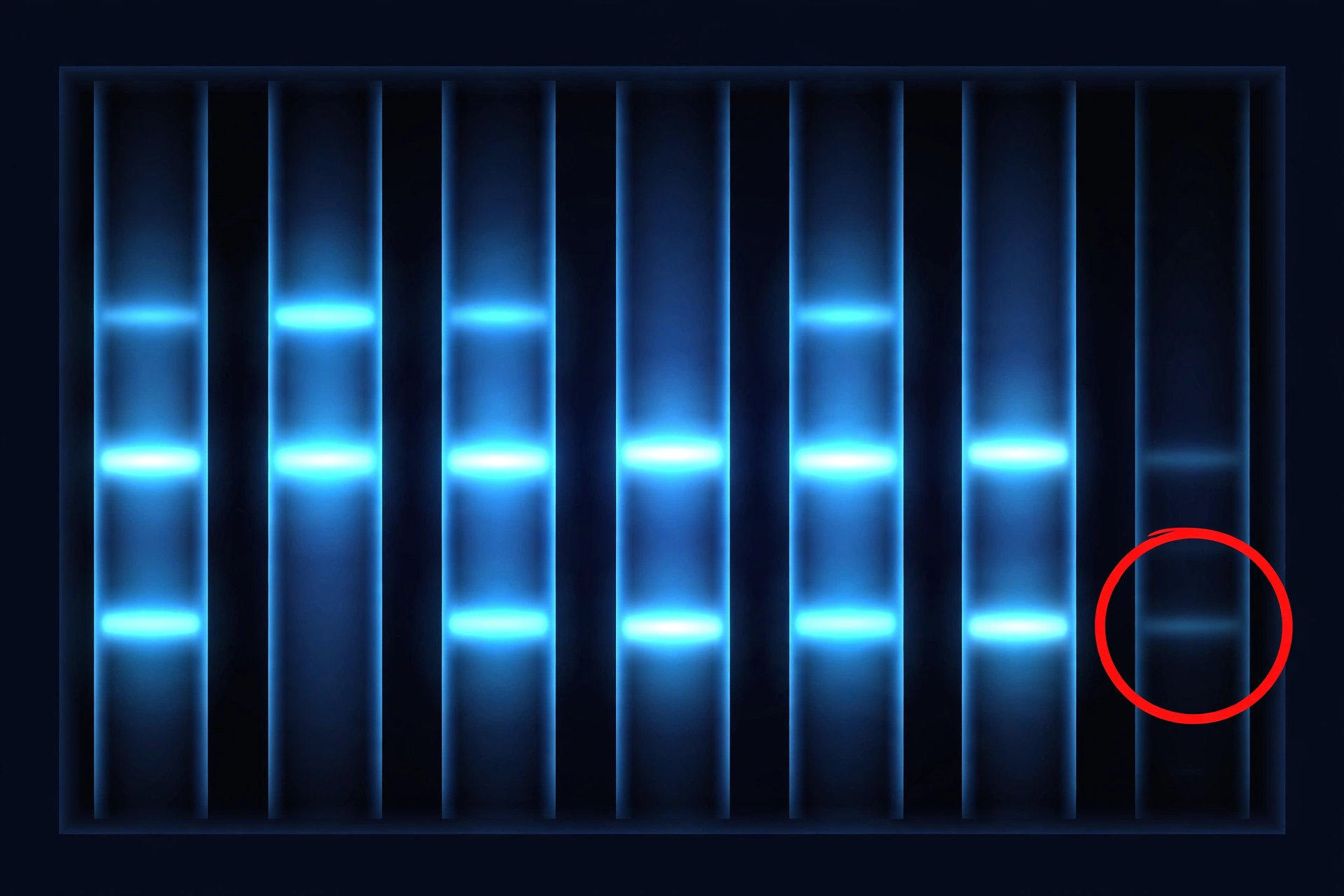
Quick answer
A band in your PCR negative control means something amplified that shouldn't have — usually template contamination, carryover product, or primer dimers. Read the band: same size as your samples means contamination; a tiny band near the bottom means primer dimers. Then replace reagents one at a time to find the culprit.
Lab forums get this question every week: "My negative control has a band — can I still trust my results?" The asker hopes for yes. Uncomfortable truth: if that band matches your product's size, the answer is no — not one lane of that gel. But read the band before you bin everything; it's genuinely diagnostic, and half the time the fix is one pipetting habit.
What Is a Negative Control in PCR — and Why That Lane Matters Most
A negative control (usually the no-template control, NTC) mirrors your samples — same mix, primers, cycling — except water replaces the template DNA. The lane should stay empty.
That empty lane does the most important job on the gel: it proves your reagents are clean. Every sample result is only believable because the negative lane stayed empty. Skipping it to "save reagents" risks entire experiments — a lesson most people learn exactly once.
What Does a Band in Your Negative Control Mean?
Read the band first — its size and brightness narrow the cause dramatically:
| What you see | What it usually means | How worried to be |
|---|---|---|
| Band the same size as your product | Template contamination — real target DNA got into the reagents | Very. The whole run is unusable. |
| Tiny band below 100 bp, fuzzy | Primer dimers — primers amplifying each other | Mild. Samples are still valid; fix the primers. |
| Faint smear across the lane | Contaminated primer or water stocks, or degraded reagents | Moderate. Repeat with fresh aliquots. |
| Band appears after many cycles only | Trace aerosol contamination, amplified late | Moderate. Clean up workflow before it gets worse. |
The same-size band is the classic signature of amplicon carryover: product from an earlier run, aerosolized when someone opened a tube, drifting into fresh reagents. PCR is exponential, so a few stray molecules bloom into a full band. A tiny bottom band is just primers dimerizing with no template to amplify.
How Do You Find the Contaminated Reagent?
Don't throw everything out and start over — you'll never find the culprit, and it'll happen again. Change one thing at a time:
1. Repeat with fresh water. Water is the most-handled reagent and the usual culprit. Open a new aliquot of nuclease-free water, remake just the negative control, and rerun. Band gone? Found it.
2. Swap reagents one by one. Still a band? Suspect the master mix or buffer next, then primers, then polymerase — one rerun per swap. Boring, but it works.
3. Check new primers separately. Ordered a pair recently? Resuspend and test them alone in water. Synthesis contamination happens more often than vendors admit.
4. Suspect the environment. If fresh reagents still fail, it's the workspace. Wipe bench and pipette barrels with 10% bleach then 70% ethanol, UV the setup area 15–30 minutes, and rerun. Setting up reactions where you run gels is the classic cause.
Also rule out spillover from the next well: overloaded neighbors can bleed into the NTC lane during loading. If only the lane's edge glows, reload with an empty well between them.
How Do You Stop It Coming Back?
Finding the culprit fixes this week. These habits fix it permanently:
Separate pre- and post-PCR. Never open product tubes — for gels, cleanup, anything — where you set up reactions. Ideal: separate rooms. Minimum: separate benches and pipette sets. Aerosolized amplicon is the top source of recurring contamination.
Use filter tips, always — they cost slightly more and save entire projects. Change gloves the moment they touch anything outside the clean zone.
Aliquot everything: split water, buffers, and primers into single-use aliquots, so one contaminated tube costs one aliquot, not the whole stock.
Consider UNG/dUTP. If you run PCR constantly, switch to dUTP and add uracil-DNA glycosylase (UNG) with a 2-minute 50 °C step before cycling. UNG destroys dUTP-containing carryover amplicons while leaving your natural template untouched — it prevents future contamination, though it can't fix what's already contaminated.
Bitesize Bio's 10 handy tips for contamination-free PCR is worth the read. If your problem is the opposite — no bands at all — or smears and extra bands, those guides have you covered.
Key takeaways
- The negative control lane must be empty — it's what makes the other lanes believable.
- Same-size band = template contamination; tiny bottom band = primer dimers. Read the band before acting.
- Find the culprit by replacing reagents one at a time, starting with water.
- Separate pre- and post-PCR areas, use filter tips, and aliquot reagents to stop it recurring.
Frequently Asked Questions
Is a faint band in the PCR negative control ever OK?
A very faint band under 100 bp is usually primer dimers — your samples stay trustworthy. A band matching your product's size is never OK: that's contamination, and nothing from that run can be trusted.
Can I trust my PCR run if the negative control has a band?
No. A same-size band means every positive could be contamination — the run must be repeated after decontamination.
Can primer dimers cause a band in the negative control?
Yes — a small, fuzzy band below 100 bp in the no-template lane is the classic primer-dimer signature. It doesn't invalidate your samples, but it steals reagents; our primer dimer guide walks through the fixes.
Setting up fresh reactions? Run primers through our free Tm calculator first, and store working stocks properly — our primer storage guide explains how degraded primers cause the faint-band problems above.